Packing heavy machinery is not like packing consumer goods. A single forged component, gearbox or CNC part can weigh hundreds of kilos, travel through multiple handling points, and sit in a container for weeks. If the packaging fails, the damage claim, the production delay and the lost buyer trust cost far more than the packaging itself.
So the question most plant heads and exporters ask is simple: wooden crate or corrugated box? The honest answer is that neither wins every time. The right choice depends on weight, shipping route, destination rules, storage conditions and budget. This guide breaks down both options so you can decide with confidence.
Why Packaging Choice Matters for Heavy Machinery
Heavy machinery faces stress that light cargo never sees: stacking pressure, forklift handling, vibration on road and rail, humidity at sea, and sudden shocks during loading. Poor packaging leads to:
- Bent shafts, cracked castings and damaged precision surfaces
- Rust and corrosion during transit and storage
- Customs delays when export packaging does not meet destination rules
- Rejected consignments and costly insurance disputes
Choosing the right packaging protects your product, your delivery schedule and your brand.
What Are Wooden Crates?
Wooden crates are rigid, frame-based enclosures made from timber, plywood or a combination of both. They are built to carry high loads and to keep the product fixed in position through rough handling. At RR Group of Industries, our wooden pallets and boxes are engineered to the weight, dimensions and handling needs of each product, including fully customised crates for odd-shaped machinery.
A modern alternative is nail-less packaging, where crates are assembled with clips and fasteners instead of nails. This makes them quicker to assemble and dismantle, safer to handle and easier to reuse.
Advantages of wooden crates
- High load capacity: suitable for very heavy and dense equipment
- Stacking strength: frames resist crushing under load
- Impact protection: rigid walls absorb knocks during handling
- Customisable: can be built around irregular shapes with internal bracing
- Reusable: well-built crates can be used for multiple trips
Limitations of wooden crates
- Heavier than corrugated boxes, which can raise freight cost
- Need heat treatment and marking for most export markets
- Higher upfront cost per unit
- Untreated timber can absorb moisture
What Are Corrugated Boxes?
Corrugated boxes are made from layered paperboard with a fluted inner layer that gives strength while keeping weight low. Multi-ply (5-ply and 7-ply) boxes and heavy-duty corrugated designs have expanded their use well beyond light goods. See our range of corrugated packaging for industrial applications.
Advantages of corrugated boxes
- Lightweight: lower freight and handling cost
- Cost-effective: economical for medium and high volumes
- Easy to customise: printing, labelling and die-cut inserts are simple
- Recyclable: supports sustainability and ESG goals
- No ISPM-15 requirement: paper-based packaging is generally not covered by wood treatment rules
Limitations of corrugated boxes
- Lower stacking and crush resistance, especially in humid conditions
- Weaker against sharp-edged or very heavy products
- Strength drops when exposed to moisture
- Usually single-use or limited reuse
Wooden Crate vs Corrugated Box: Side-by-Side Comparison
| Factor | Wooden Crate | Corrugated Box |
|---|---|---|
| Load capacity | Very high | Low to medium (heavy-duty variants higher) |
| Stacking strength | Excellent | Moderate |
| Weight of packaging | Heavy | Light |
| Moisture resistance | Good if treated | Weak unless coated or protected |
| Reusability | High | Low |
| Upfront cost per unit | Higher | Lower |
| Customisation for odd shapes | Excellent | Good for standard shapes |
| Export compliance | ISPM-15 treatment needed | Generally not required |
| Recyclability | Reusable, repurposable | Fully recyclable |
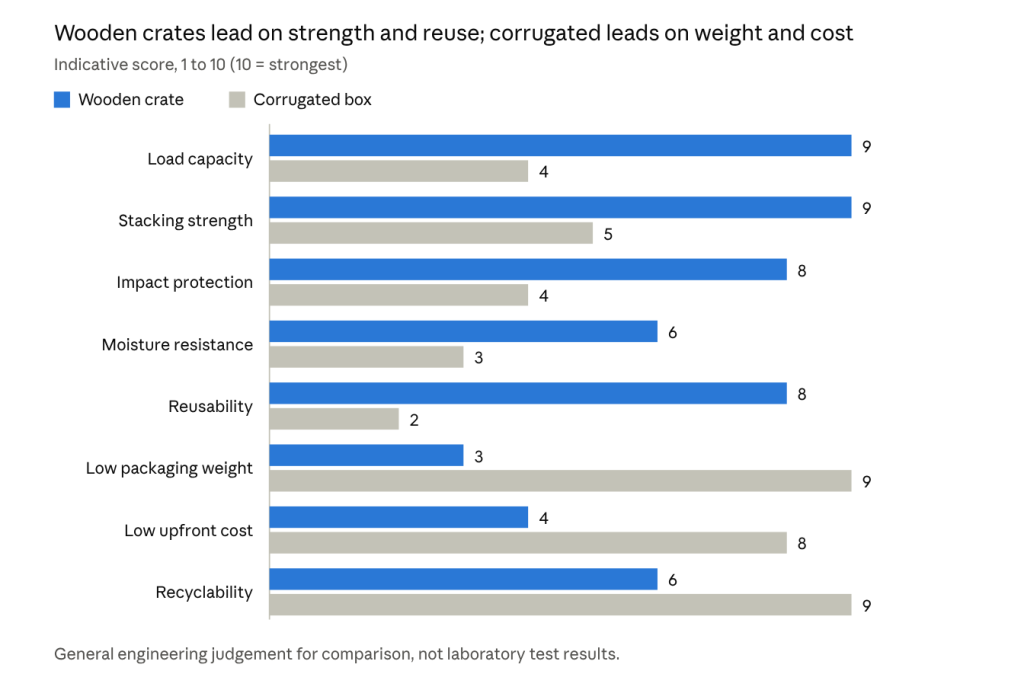
Read the chart as a trade-off: no packaging type wins every factor, which is why many shippers combine both.
Key Factors to Consider Before You Choose
1. Weight and density of the machinery
This is the first filter. As a general rule, the heavier and denser the product, the stronger the case for a wooden crate or a fabricated frame. Heavy-duty corrugated works for lighter components, sub-assemblies and spares, but it is rarely the right call for a multi-hundred-kilo machine.
2. Shipping mode and distance
Local road movement within Maharashtra is very different from a sea shipment to Europe. Long-haul and multi-modal routes involve more handling, more vibration and more exposure to humidity. Longer routes tilt the decision toward wooden crates.
3. Export destination and compliance
Most countries require wooden packaging to follow ISPM-15, the international standard for treating and marking wood packaging material to prevent the spread of pests. You can read more on the IPPC ISPM standards page. Non-compliant wooden crates can be held, fumigated or rejected at the destination port. Corrugated packaging is generally outside this requirement, which is one reason some exporters use it for lighter consignments.
4. Storage conditions and humidity
If the machine will wait in a yard or warehouse, or travel by sea, moisture is the enemy of both the product and the box. Pair your packaging with VCI packaging to prevent rust on metal parts, whichever outer packaging you choose.
5. Reusability and total cost
A corrugated box looks cheaper on a quote. But if a wooden crate can be reused across several shipments, or returned and repaired, the cost per trip may be lower. Always compare cost per safe delivery, not just cost per unit.
[embed: node/0582e64b-813b]
The crate’s higher price pays back only through reuse; for one-way shipments, the corrugated box stays cheaper.
When to Choose a Wooden Crate
Go with wooden crates when:
- The machine or component is very heavy, dense or high-value
- The product has an irregular shape or protruding parts
- You are shipping by sea or over long distances
- Units will be stacked or stored for long periods
- You want reusable packaging for repeat shipments
When to Choose a Corrugated Box
Corrugated boxes make sense when:
- Components are light to medium weight
- Shipments are domestic or short-haul
- You ship in high volumes and need low-cost, uniform packaging
- Sustainability and recyclability are priorities
- The product needs branded or printed packaging
The Hybrid Approach: Often the Smartest Choice
Many industrial shippers do not choose one or the other. A common approach is to place smaller parts in corrugated boxes and secure them on a wooden pallet or inside a larger crate. Add heat shrink packaging to hold loads tight and protect against dust and moisture, and you get strong, cost-balanced protection.
For repeat shipments within a supply chain, returnable packaging such as polypropylene boxes can also reduce long-term packaging spend.
Common Mistakes to Avoid
- Choosing on price alone: a cheap box that fails costs more than a strong crate
- Ignoring ISPM-15: non-compliant wood can block your shipment
- Skipping rust protection: metal parts need VCI or desiccant support
- Poor internal bracing: even a strong crate fails if the product shifts inside
- Wrong crate size: oversized crates waste freight cost; undersized ones damage the product
Get It Packed Right, Where You Are
If you manufacture in bulk or ship oversized machines, moving the product to a packing unit adds handling risk. Our onsite packaging services bring trained teams and materials to your plant so the machine is packed where it is built.
Conclusion
There is no single winner in the wooden crate vs corrugated box debate. Wooden crates are the safer choice for heavy, high-value, long-distance and export machinery. Corrugated boxes work well for lighter, domestic and high-volume shipments, and they are easier on the budget and the environment. For many manufacturers, a hybrid of both gives the best balance of protection and cost.
The best way to decide is to look at your product weight, route, destination rules and storage conditions together, and to compare the cost per safe delivery rather than the cost per box.
Need Packaging for Your Heavy Machinery?
RR Group of Industries has over 30 years of experience designing wooden crates, nail-less packaging, corrugated boxes, metal and returnable packaging for automobile, engineering, defence, power and many other industries from our base in Pune.
Get a free packaging consultation and quote or call us at +91 992 2966 457, or email info@rrpackaging.net.
Frequently Asked Questions
Which is better for heavy machinery: wooden crate or corrugated box? For heavy, dense or high-value machinery, wooden crates are generally the better choice because of their load capacity and stacking strength. Corrugated boxes suit lighter parts.
Do wooden crates need ISPM-15 certification for export? In most cases, yes. Wood packaging material used for export typically needs heat treatment and ISPM-15 marking. Always confirm the rules of your destination country.
Can corrugated boxes be used for export shipments? Yes, for lighter goods. Heavy-duty multi-ply corrugated can work for medium-weight products, but it is not recommended for very heavy machinery.
Are nail-less crates as strong as nailed crates? Well-designed nail-less crates offer comparable strength, with the added benefits of faster assembly, safer handling and easier reuse.
How do I stop rust on machinery during shipping? Use VCI packaging along with moisture barriers or desiccants inside the crate, and choose packaging that protects against humidity for sea freight.