Every time a finished product is lifted, moved, loaded or unloaded, something can go wrong. A forklift tine catches a corner, a strap slips, a crate is stacked wrongly, or a delicate part sits in a yard for a day too long. For manufacturers of heavy engineering goods, auto components and export cargo, these small risks add up to real money: damage claims, rework, delayed dispatches and unhappy buyers.
One of the most effective ways to cut that risk is to change where packing happens. With onsite industrial packaging, the packing team and materials come to your plant, warehouse or dispatch yard, so the product is packed where it is made. This guide explains how that works and how it reduces both handling costs and product damage.
What Is Onsite Industrial Packaging?
Onsite industrial packaging means a packaging partner sets up inside or beside your facility and packs finished goods there, instead of you transporting products to an external packing unit. The partner brings trained crews, tools, materials and a defined process.
At RR Group of Industries, our onsite packaging services cover custom crates, pallets, corrugated packing, shrink wrapping and rust protection, all matched to the product and the destination.
Where Handling Costs and Product Damage Come From
Before looking at the fix, it helps to see where the losses start. In a typical offsite packing flow, a product may be:
- Moved from the production line to a staging or yard area
- Loaded onto a vehicle and driven to a packing unit
- Unloaded and stored at the packing unit until it is packed
- Reloaded after packing and sent back for dispatch
- Loaded again onto the final transport vehicle
Each step needs labour, equipment and time, and each one is a chance for impact, tilting, moisture exposure or mishandling. The more a product moves before it ships, the higher the cost and the risk.
How Onsite Packaging Reduces Handling Costs
1. Fewer handling steps
The biggest saving comes from removing steps. When packing happens at your site, the product goes from the production area to the packing area and then to dispatch. The transport legs to and from an outside packing unit disappear.
[embed: node/18ca0c0c-f630]
The two steps that remain are the ones every product needs: moving it to the packing area and loading it for dispatch.
2. No extra transport to a packing unit
Moving heavy or oversized products to an external unit means vehicles, drivers, loading crews and sometimes escort or permit costs. Onsite packing removes these inbound and outbound runs completely.
3. Packing matched to your production and dispatch schedule
A packing crew that works on your site can pack as products come off the line or are cleared by quality control. This reduces waiting time, yard storage and the idle inventory that builds up when products wait for a vehicle or a packing slot.
4. Better use of your own manpower and equipment
Your team and your material handling equipment stay focused on production and dispatch. Where you need extra lifting capacity, MHE lease modeling lets you add forklifts or pallet jacks without a large capital outlay.
5. Packaging designed once and repeated consistently
An onsite team works from a defined packing specification for each product. That consistency avoids both under-packing, which causes damage, and over-packing, which wastes material and freight volume.
How Onsite Packaging Reduces Product Damage
1. Packing at the source means less exposure
Products are packed soon after they are finished, so they spend less time exposed to dust, rain, humidity and yard traffic.
2. Custom-fit packaging for each product
Because the crew can measure and fit packaging against the actual product, crates, blocking and bracing can be made to suit its weight, centre of gravity and fragile points. Options include wooden pallets and boxes, nail-less packaging and fabricated metal packaging for the heaviest loads.
3. Corrosion and moisture protection built in
Metal parts waiting for dispatch or travelling by sea are at risk of rust. Onsite crews can apply VCI packaging and moisture barriers right after final inspection, and secure loads with heat shrink packaging to keep dust and water out.
4. Trained crews and repeatable processes
Professional packing teams follow set procedures for lashing, blocking, labelling and load balancing. This reduces the variation that comes from ad hoc packing by whichever staff are available.
5. Quality checks at the source
Your quality and dispatch teams can inspect packing before the product leaves the site. Problems are caught while the product is still on your premises, not after it arrives at the port or the customer.
Onsite vs Offsite Packing: A Quick Comparison
| Factor | Onsite packing | Offsite packing |
|---|---|---|
| Handling steps | Fewer | More |
| Transport to a packing unit | Not needed | Needed both ways |
| Damage risk from movement | Lower | Higher |
| Control and inspection | Direct, at your site | Limited |
| Suitability for oversized goods | Very good | Difficult and costly |
| Fit with production schedule | Flexible and in sync | Depends on transport and slots |
| Space needed at your site | Some packing area required | None |
Onsite packing needs some working space and coordination at your plant. For most manufacturers shipping heavy or high-value products, that is a small trade-off for the savings.
What Does the Cost Picture Look Like?
The chart below shows how an illustrative cost per consignment can shift when packing moves onsite. Actual numbers depend on your product, volumes and location, but the pattern is common: transport and handling costs fall sharply, while the packing cost itself stays similar.
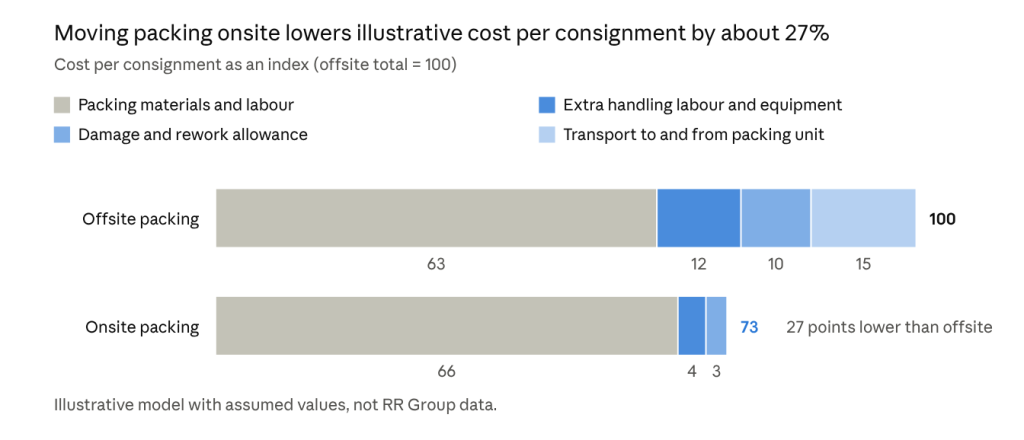
The packing cost itself barely changes. The saving comes from the transport, handling and damage lines.
Who Benefits Most from Onsite Packaging?
Onsite industrial packaging works especially well for:
- Heavy engineering and machinery: oversized, heavy items that are hard to move twice
- Automobile and auto component makers: high volumes and tight dispatch schedules
- Defence, aviation and power equipment: high-value goods that need careful, documented packing
- Exporters shipping in bulk: consignments that need consistent, compliant packing. Our guide on onsite packaging services in Gujarat explains why bulk exporters prefer on-location packing.
- Manufacturers with limited packing capacity: plants that want to scale dispatch without building their own packing department
How to Choose an Onsite Packaging Partner
Before signing up, check for these points:
- Experience with products like yours, in your industry
- Ability to design and make custom packaging, not just supply standard boxes
- Knowledge of export rules, including ISPM-15 treatment for wood packaging where it applies
- Trained crews, safe working practices and clear supervision
- Willingness to test and improve packing designs. Industry transit-testing bodies such as ISTA publish test procedures that many shippers use to validate packaging
- Support for related needs such as warehouse management and equipment
Common Mistakes to Avoid
- Treating packing as an afterthought: involve your packaging partner while planning dispatch, not the day before shipping
- No packing specification: write down how each product should be packed, so results stay the same across crews and shipments
- Ignoring moisture and rust risk: plan protection for sea freight and monsoon-season storage
- Skipping a trial run: pack and test a sample consignment before scaling
- Choosing on rate alone: compare total cost, including handling, transport and damage, not just the packing charge
Conclusion
Onsite industrial packaging reduces handling costs and product damage for a simple reason: the product moves less. Fewer lifts, fewer vehicle runs and fewer hours in storage mean lower cost, lower risk and faster dispatch. Add custom-fit packaging, built-in corrosion protection and quality checks at the source, and your products reach the customer in the condition they left your factory.
If your team currently ships products to an outside unit for packing, or struggles with damage on heavy and export cargo, it is worth comparing the full cost of both models.
Talk to RR Group About Onsite Packaging
RR Group of Industries brings over 30 years of experience in industrial packaging, with crews and materials that come to your plant. We design packaging for your product, whether it is a heavy machine, an auto component batch or an export consignment.
Request a free onsite packaging assessment or call us at +91 992 2966 457, or email info@rrpackaging.net.
Frequently Asked Questions
What is onsite industrial packaging? It is a service where a packaging company sends trained crews and materials to your plant or warehouse and packs your products there, instead of you sending products to an outside packing unit.
How does onsite packaging reduce handling costs? It removes transport and handling steps between production and dispatch, which saves vehicle, labour and equipment costs.
Does onsite packing reduce product damage? Yes. Fewer movements, custom-fit packaging and quality checks at the source all lower the chance of damage in transit.
Is onsite packaging suitable for oversized or very heavy products? It is often the best option for them, because moving oversized goods twice is costly and risky.
Can onsite packaging support export shipments? Yes. Crews can pack to export requirements, including treated wood packaging and corrosion protection, ready for container loading.