If you have ever watched a nailed crate being opened at a warehouse, you know the routine: crowbars, hammers, bent nails on the floor and splintered planks. The crate is destroyed, the nails become scrap, and someone gets hurt more often than anyone admits. For exporters and manufacturers who ship heavy goods regularly, that is wasted material, wasted time and avoidable risk.
Nail-less wooden crates solve this problem by replacing nails with clips, fasteners and engineered joints. The crate goes together quickly, comes apart cleanly and can be used again. This guide explains how nail-less crates work, where they fit best and why they have become a preferred choice for export packaging.
What Are Nail-Less Wooden Crates?
Nail-less wooden crates are wooden packing cases assembled without nails. Instead of driving a nail through each joint, the panels, frames and base are held together with metal clips, straps, fasteners or interlocking joints. The result is a rigid crate that can be assembled and dismantled with simple tools and without damaging the wood.
At RR Group of Industries, nail-less packaging is designed around each product’s weight, size and shipping route, and sits alongside our wider range of wooden pallets and boxes.
Nailed vs Nail-Less Crates: What Is Different?
| Factor | Nailed crate | Nail-less crate |
|---|---|---|
| Assembly | Hammering, slower, skilled labour | Clip or fastener based, faster |
| Dismantling | Destructive, crowbars needed | Clean, planned dismantling |
| Reusability | Low, panels often split | High, panels stay intact |
| Handler safety | Risk from nails and splinters | Lower risk |
| Customs inspection | Often means breaking the crate | Easier to open and re-close |
| Return or storage space | Bulky if kept assembled | Can be stored or returned flat |
| Waste at destination | Wood plus loose nails | Cleaner, easier to separate and reuse |
| Upfront cost | Lower | Usually higher |
The trade-off is clear: nail-less crates can cost more upfront, but they recover that cost through reuse, speed and lower handling risk.
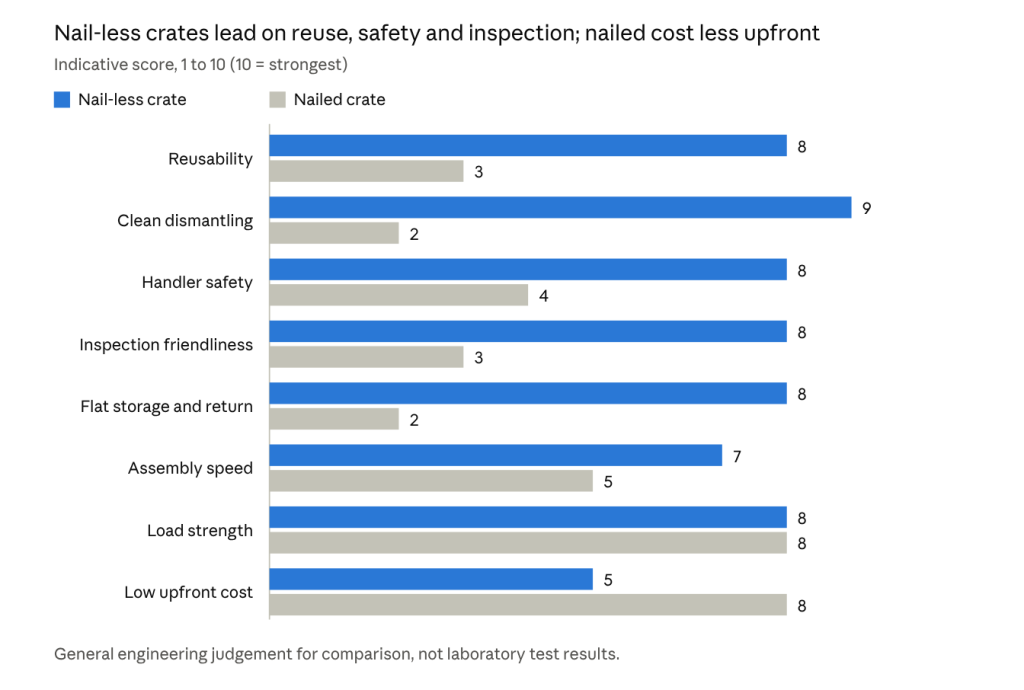
Load strength is a tie when both are designed well; the real differences show up in handling, reuse and inspection.
Key Benefits of Nail-Less Wooden Crates
1. Faster assembly and dismantling
Clip-based construction cuts assembly time and does not need heavy hammering. At the destination, the crate can be opened in a planned way, so the goods are accessed faster and with less shock to the product inside.
2. Reusable and cost-effective over time
Because panels are not split by pulling nails, they can be reused across several shipments. For repeat routes, such as a supplier sending components to the same plant, this brings down the cost per trip.
3. Safer for workers and for the product
No protruding nails means fewer cuts and punctures for handlers. Opening a crate with less force also reduces vibration and impact on the equipment inside.
4. Easier customs and quality inspection
Inspectors sometimes need to see inside a consignment. A nail-less crate can be opened and closed again without destroying it, which helps protect the cargo and keeps the packaging usable after inspection.
5. Flat storage and lighter return logistics
A dismantled crate takes up a fraction of the space of an assembled one. That matters for storing empty crates at your plant, and for returning them to the supplier or exporter.
[embed: node/cf9b92fc-caed]
The saving grows with every crate you return, which matters most on regular supplier-to-plant routes.
6. Supports sustainability goals
Reusing wooden crates, and repairing or repurposing them at the end of life, reduces waste and raw material use. This fits RR Group’s approach to using wood and metal in ways that cause the least harm to the environment.
Export Packaging Advantages
Export shipments face more rules, more handling and longer transit than domestic loads. Nail-less crates help in four ways.
- Compliance support: wooden packaging used in international trade generally needs treatment and marking under ISPM-15, the global standard for wood packaging material. See the IPPC page on ISPM standards for the official rules, and always check the requirements of your destination country.
- Inspection-friendly design: crates can be opened and closed for checks without being destroyed.
- Strong, stable loads: engineered joints and bracing hold heavy machinery steady through sea and road transit.
- Better protection with add-ons: pair crates with VCI packaging to prevent rust and with heat shrink packaging to keep moisture and dust out.
For bulk exporters, packing the crates at the source can also help. Our guide on onsite packaging services in Gujarat explains why many manufacturers prefer on-location packing for export consignments.
Where Nail-Less Crates Are Used
Nail-less crates suit any industry that ships heavy, valuable or sensitive goods:
- Automobile and auto components: engines, gearboxes, axles and assemblies
- Heavy engineering: machine tools, castings, forgings and fabricated parts
- Electrical and power equipment: transformers, panels, motors and control gear
- Aviation and defence: precision parts that need secure, documented packing
- Pharma and process equipment: machinery that must arrive clean and undamaged
- Agriculture and mining equipment: large components for domestic and export markets
How to Choose the Right Nail-Less Crate
Before ordering, work through these points with your packaging partner:
- Product weight and dimensions: the crate base and bracing must match the load
- Centre of gravity: heavy, uneven loads need internal supports and tie-down points
- Route and mode: sea freight needs more moisture and stacking protection than local road transport
- Destination rules: confirm wood treatment, marking and documentation requirements
- Reuse plan: decide whether crates will be returned, stored or repurposed
- Validation: consider drop, vibration and compression testing. Transit-testing bodies such as ISTA publish widely used test procedures
Common Mistakes to Avoid
- Choosing on upfront price alone: compare cost per trip, not cost per crate
- Skipping treatment and marking for export wood: non-compliant crates can be held or rejected at the port
- Poor internal blocking: a strong crate still fails if the product shifts inside
- Wrong crate size: oversized crates waste freight, undersized ones damage the product
- Ignoring rust risk: metal parts need VCI or moisture protection, whatever the crate type
Conclusion
Nail-less wooden crates are a smart upgrade for manufacturers and exporters who ship heavy goods. They assemble quickly, open cleanly, protect handlers, support customs inspection and can be reused or returned flat. The higher upfront cost is usually offset by lower cost per trip and fewer damage and safety problems.
If your shipments follow repeat routes, or you are preparing for export, nail-less packaging is worth a close look.
Get Nail-Less Packaging From RR Group
RR Group of Industries has over 30 years of experience designing wooden, nail-less, metal and returnable packaging for automobile, engineering, electrical, defence and many other industries, from our base in Pune.
Request a nail-less packaging quote or call us at +91 992 2966 457, or email info@rrpackaging.net.
Frequently Asked Questions
What is a nail-less wooden crate? It is a wooden crate assembled with clips, fasteners or interlocking joints instead of nails, so it can be built and taken apart without damaging the wood.
Are nail-less crates strong enough for heavy machinery? Yes, when designed correctly. Engineered joints, bracing and a suitable base allow them to carry heavy equipment. The design should always match the product weight and route.
Do nail-less crates need ISPM-15 treatment for export? In most cases, yes, because they are still made of wood. Treatment and marking rules apply to wood packaging material used in international trade, so confirm your destination’s requirements.
Can nail-less crates be reused? Yes. Because they can be dismantled without splitting the panels, they are well suited to repeated use on regular routes.
Are nail-less crates more expensive than nailed crates? They often cost more upfront, but reuse, faster handling and lower damage risk can bring the cost per trip down over time.