Manufacturing plants handle materials every day—from raw metal and machine parts to finished assemblies. When these materials are moved using unsuitable or inconsistent equipment, the result can be avoidable damage, wasted movement, production delays and higher handling costs. Custom metal pallets and industrial trolleys offer a practical way to make internal material movement safer, more organised and more efficient.
Why Material Handling Equipment Matters in Manufacturing
Material handling is more than moving a component from one point to another. It includes lifting, storing, protecting, positioning and transferring materials throughout the production process. The right handling equipment helps keep materials flowing between receiving, machining, assembly, inspection, storage and dispatch.
Standard containers or general-purpose carts may not suit every component. Automotive, engineering and fabrication businesses often work with parts that have specific dimensions, weights, surface finishes and handling requirements. A purpose-designed pallet or trolley can be built around these operating conditions, helping teams move components in a repeatable way.
What Are Custom Metal Pallets?
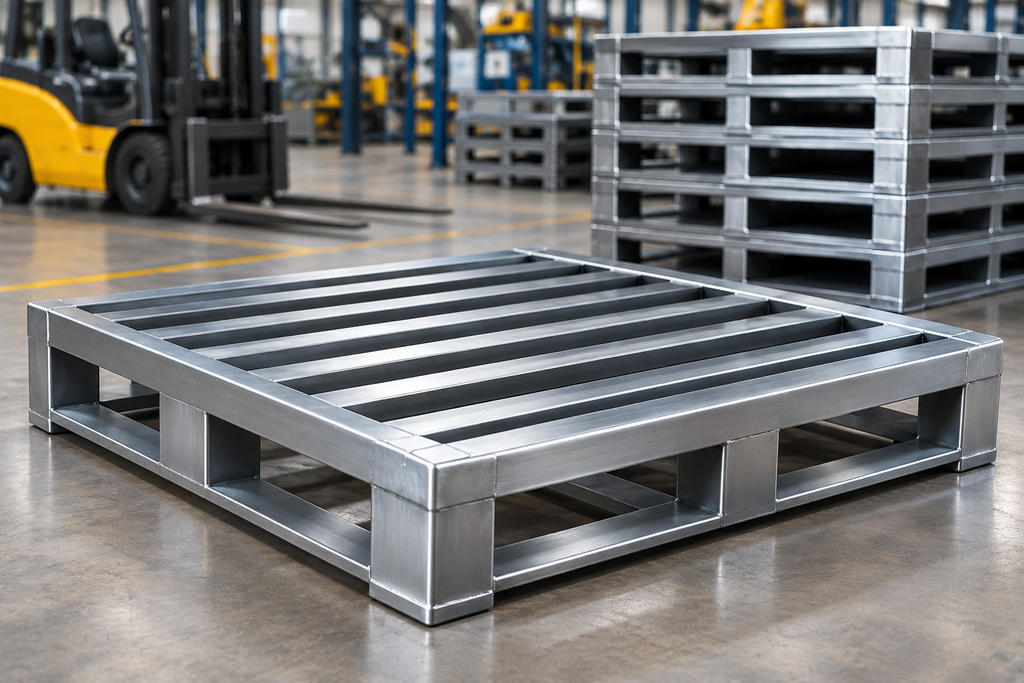
Custom metal pallets are reusable load-carrying platforms designed to support, store and transport materials within a facility or across a supply chain. Unlike a one-size-fits-all platform, a custom pallet is developed around the product and the process: its footprint, load, centre of gravity, contact points, stacking needs and handling method.
Common Features of a Custom Metal Pallet
- Specified dimensions to fit the component, storage rack or production station.
- Load-bearing frame and supports selected for the expected working load and handling conditions.
- Forklift or pallet-truck entry designed to suit the equipment used on site.
- Locators, separators, pockets or fixtures that help keep parts in position.
- Stacking or nesting features where storage density and return logistics matter.
- Protective contact surfaces or suitable finishes to reduce the risk of scratches and corrosion.
Why Customisation Is Important
A pallet that is too large can waste floor and vehicle space; one that is too small or poorly supported can create instability. Custom design allows the packaging or handling unit to match the actual product geometry and workflow. It can also make loading and unloading more consistent, reducing the need for improvised packing materials or repeated manual adjustments.
How Industrial Trolleys Improve In-Plant Movement
Industrial trolleys are wheeled platforms or frames used to move components, tools, work-in-progress and finished goods over short distances. They are especially useful where materials travel frequently between workstations and where forklift movement may be impractical or unnecessary.
Types of Trolleys Used in Manufacturing
1. Platform Trolleys
A flat platform with wheels for moving boxes, bins, fixtures or general components. Deck size, wheel type and handle design should reflect the load and floor conditions.
2. Component-Specific Trolleys
These include dedicated slots, racks, dividers or supports to hold parts in a defined position. They can be useful for fragile, finished or geometry-sensitive components that should not rub against one another.
3. Multi-Tier Trolleys
Multiple shelves or levels allow different parts, kits or process batches to be moved together while keeping them separated and accessible.
4. Heavy-Duty Trolleys
Reinforced frames and appropriately rated wheels help move heavier loads. Capacity should be specified for the complete trolley system, including the deck, frame, castors and operating conditions.
Key Benefits for Manufacturing Operations
1. Better Workflow and Less Material-Handling Time
Dedicated pallets and trolleys give materials a defined route and a consistent handling method. When components arrive at the next workstation in an organised unit, employees spend less time sorting, repositioning and searching for parts. This can support smoother movement between production stages.
2. Improved Component Protection
Correctly designed supports, dividers and locating points help prevent components from shifting, colliding or rubbing during movement. For machined, painted or precision-finished parts, this can reduce the risk of handling-related surface damage. Protection still depends on suitable design, loading practices and inspection.
3. Safer and More Ergonomic Handling
Trolleys can reduce repeated carrying and awkward manual transfers. Pallets designed for compatible forklifts or pallet trucks can also reduce unnecessary manual lifting. Equipment selection must consider load limits, wheel and handle condition, floor gradients, turning space and safe operating procedures.
4. Better Space Utilisation
Stackable or nestable pallets can help use storage space more effectively when designed for the relevant load and stacking height. Trolleys with defined compartments can keep work-in-progress organised and reduce clutter around production lines.
5. Reusability and Long-Term Value
Metal handling units are often selected for repeated industrial use. Their service life depends on material selection, fabrication quality, load discipline, environment and maintenance. A reusable system may reduce recurring spend on disposable handling solutions, although the total cost should include purchase, repair, cleaning, return transport and storage.
How to Choose the Right Metal Pallet or Trolley
Before requesting a design or quotation, document the real operating requirements. A clear specification helps the manufacturer recommend a practical solution rather than simply reproducing the dimensions of an existing unit.
A Practical Selection Checklist
| Parameter | What to confirm |
| Product details | Component dimensions, weight, shape, surface finish and contact points |
| Load capacity | Maximum payload, load distribution and expected handling frequency |
| Movement method | Forklift, pallet truck, tugger, manual push or conveyor interface |
| Storage needs | Stacking, nesting, rack compatibility and available floor space |
| Operating environment | Indoor/outdoor use, moisture, chemicals, temperature and cleaning |
| Safety and usability | Stability, edge protection, handle height, castors, brakes and visibility |
| Lifecycle | Expected reuse cycles, repairability, inspection and return logistics |
Important: Rated capacity and safe working limits should be confirmed by the equipment manufacturer. Do not estimate capacity from appearance or use a damaged pallet or trolley.
Integrating Pallets and Trolleys into the Production Process
The best results come when handling equipment is considered as part of the production system. Map the movement of a component from receiving to dispatch. Identify where it is loaded, unloaded, inspected, stored and transferred. Then check whether one standardised pallet can serve multiple stages or whether dedicated units are needed for specific operations.
Simple Implementation Steps
- Map the material flow and identify delays, repeated handling and damage points.
- Record component sizes, weights, batch quantities and movement frequency.
- Define the equipment interface, such as forklift entry, trolley route or workstation height.
- Review a prototype with operators before approving the final design.
- Train employees on loading, stacking, movement and inspection procedures.
- Track results such as handling time, damage incidents, space used and repair frequency.
Indicative Process Improvement: Before and After
The following is an illustrative comparison of operational areas that a well-matched handling system can improve. It is not a measured result or a performance guarantee; actual outcomes depend on the plant, component and implementation.
| Area | Without a tailored system | With a tailored system |
| Component movement | Ad-hoc carrying or mixed containers | Defined trolley or pallet route |
| Part arrangement | Manual sorting at each stage | Dedicated slots, separators or locations |
| Storage | Inconsistent footprints | Standardised footprints and stacking plan |
| Handling damage | Risk of parts shifting or contacting | Purpose-designed supports and restraints |
| Process visibility | Difficult to identify batches | Labelled, organised handling units |
Visual suggestion for the website: use a two-panel illustration showing mixed components being moved in general-purpose containers versus the same components secured in a purpose-built metal pallet or trolley. Add labels for stability, part separation and handling route.
Why Work with an Industrial Packaging Specialist?
A specialist can help translate product and process requirements into a handling solution. The discussion should cover not only fabrication, but also how the pallet or trolley will be loaded, moved, stored, maintained and returned. RR Group Industries can be positioned as a partner for businesses evaluating industrial packaging and material-handling requirements. Share your component details and operating conditions so the appropriate solution can be discussed.
Explore RR Group Industries: RR Packaging website
Frequently Asked Questions
What is the difference between a metal pallet and an industrial trolley?
A metal pallet is primarily a load platform for storing and transporting goods, commonly using a forklift or pallet truck. An industrial trolley is wheeled and is generally used for moving materials between nearby work areas. Some operations use both as part of one handling system.
Can metal pallets be customised for automotive components?
Yes. They can be designed around component dimensions, weight, surface finish, stacking needs and the plant’s handling equipment. The design should be validated against the actual part and operating process.
Are metal pallets suitable for repeated use?
They are commonly selected for repeated industrial handling. Service life depends on design, fabrication, loading discipline, environment, maintenance and repair practices.
How do trolleys help reduce manual handling?
They allow loads to be moved on wheels rather than carried by employees. Correct capacity, wheel selection, route condition and safe-use training remain essential.
What information is needed to request a custom pallet or trolley?
Provide component dimensions and weight, required quantity, load orientation, handling equipment, storage method, operating environment and any protection or separation requirements. Drawings or photographs can also help clarify the application.
Can custom pallets improve warehouse space utilisation?
They may improve space use when their footprint, stacking or nesting arrangement is designed around the storage layout and material flow. Actual space savings should be checked against aisle access, rack limits and safe stacking requirements.
Conclusion
Efficient manufacturing depends on a reliable flow of materials between people, machines and storage areas. Custom metal pallets and industrial trolleys can help create that flow by improving organisation, supporting component protection, reducing repeated manual handling and making internal movement more consistent. The right solution starts with the product and the process—not a standard size selected without context.
Make Material Handling Work Better for Your Plant
Looking for custom metal pallets or industrial trolleys for your manufacturing operation? Visit RR Group Industries and get in touch to discuss your component dimensions, load requirements and material-handling workflow.